The Monk Who Knew Everything
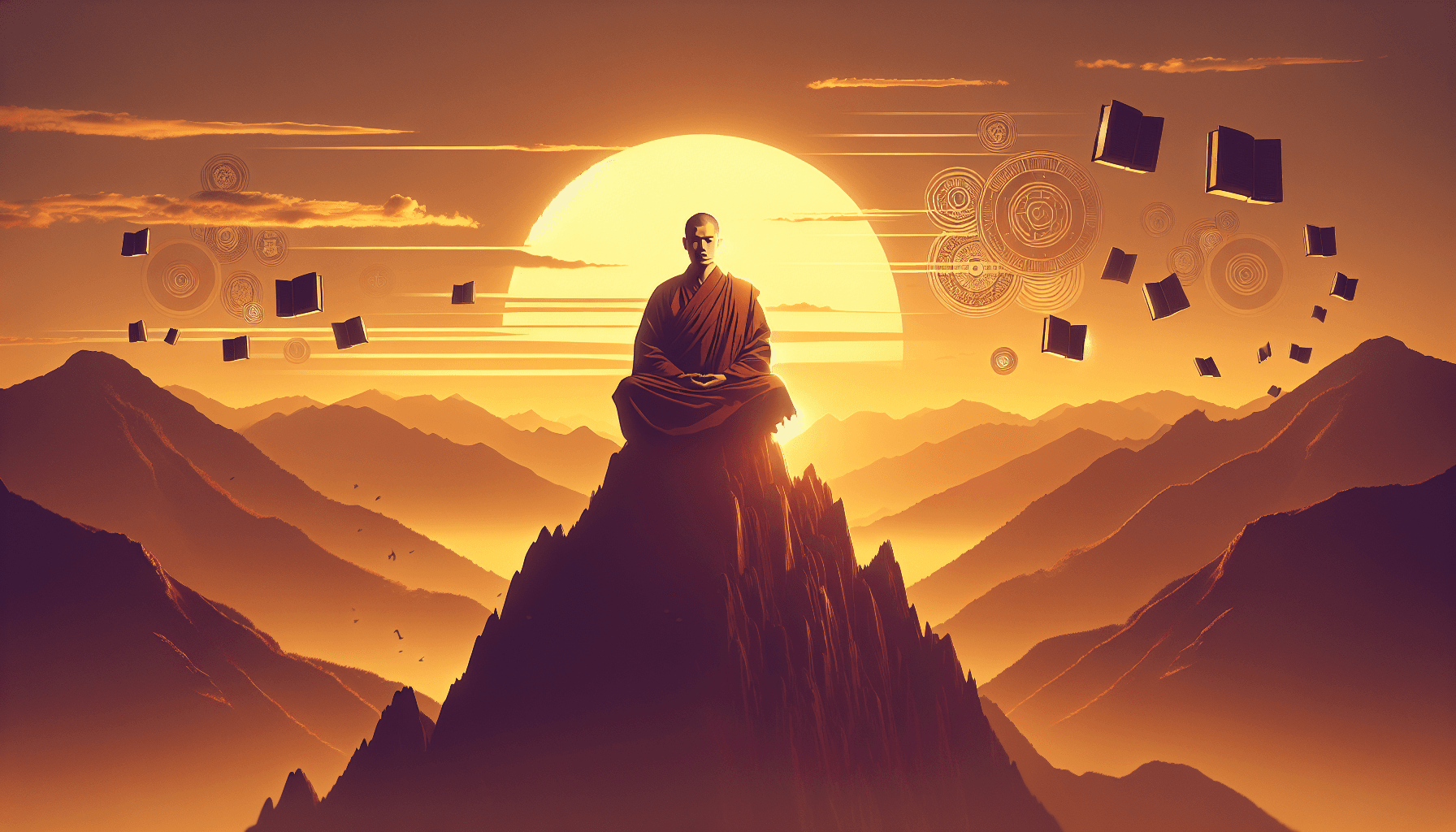
In a mountain temple of some dynasty, some era, there was a monk of great renown. His dharma name was Zhizhuo. Since he was considered enlightened, let us call him Master Zhizhuo.
Master Zhizhuo had been an orphan since birth. At six, the monks of this ancient temple took him in. At fourteen, he shaved his head and took his vows. From that day forward, for decades without interruption, he devoted himself single-mindedly to the study of Buddhist scripture, seeking nothing less than the ultimate liberation — to reach the Pure Land of the West and leave behind every sorrow of the human world.
His mastery of the dharma was already deep, yet compared to his devotion, it was nothing. For Zhizhuo had been gifted from childhood — brilliant, widely read, sharp in thought and vast in knowledge, and handsome besides, as if every virtue a person could possess had gathered in one body. Had these gifts belonged to an ordinary man, he would have ranked first in the imperial examinations, risen swiftly in office, married well, and lived like an immortal. But in Zhizhuo, these gifts became obstacles to his practice. Handsome or ugly, to him it was all the same — just a skin sack. But the world didn't see it that way. From the time Zhizhuo came of age, young women would visit the temple under the pretense of burning incense, whispering behind his back, then running off in shy laughter. Some bolder ones left silk handkerchiefs as tokens. Others quietly sent messengers urging him to return to lay life. None of this ever touched him. At most, he would offer a gentle, pitying smile — the look of a man who saw all beings drowning in the ocean of desire.
Neither love nor glory could move him. As his reputation grew, every local governor sought his counsel — some genuinely, others merely to burnish their own name as seekers of wisdom. The offers were always extraordinary. But Zhizhuo's heart remained still as water. Even when the Emperor himself issued summons, repeatedly, the master would not come.
If wealth and honor proved nothing, then hardship and danger proved equally little. To deepen his practice, he once walked on foot to every famous temple in the land. The difficulties need not be described: there were times when he was trapped in mountains for over a month, times when bandits nearly took his life, and encounters with wolves and tigers too numerous to count. Perhaps through the boundless protection of the dharma, or perhaps through mere luck, he survived each crisis. And every hardship only strengthened his resolve.
Someone who knew him once said: his ambition was like an eagle circling the vast blue sky, looking down upon the entire earth. If only he would land, the whole world would be his. But he never let his wings touch the ground. His aim lay beyond the highest heavens. To everything below, that was a castle in the air — but to Zhizhuo, it was the only thing worth reaching for. And so he would fly upward, always upward, for the rest of his life.
This anonymous observation was precise. It captured the arc of his entire existence. His indifference to worldly things mirrored perfectly his spiritual hunger. But the world has a strange way about it: the less you want, the more you receive; the more you want, the less you get. Zhizhuo's fame spread across the land. The temple became known everywhere. And yet — only the fish knows how the water feels. If anything still troubled the master, it was this: after decades of study, he had not advanced. He had read the vast ocean of sutras for a lifetime. To others he was still the enlightened master. But he knew the truth — he was merely learned. Something remained unpenetrated, and he couldn't identify what. The word "sudden awakening" in the scriptures — he had never once experienced it. In meditation, sometimes he would feel that state of perfect lightness, perfect joy — and then a single worldly thought would arise, and it would vanish instantly. This suffering, though on a different plane from ordinary frustration, shared its essential shape: to see it, to almost touch it, and yet never to grasp it. That is the deepest pain of any pursuit.
But time waits for no one. Common man or enlightened monk — anyone still carrying this body will one day reach the end. The renowned Master Zhizhuo was no exception. One day, at the age of ninety, while sitting in meditation, he sensed faintly that his time had come. He summoned all the disciples in the temple. For his final teaching, he chose the most ordinary text of all — the Heart Sutra: "Avalokiteshvara, when practicing deeply the Prajnaparamita, perceived that all five skandhas are empty, and was saved from all suffering and distress. Shariputra, form does not differ from emptiness, emptiness does not differ from form..."
His voice grew quieter as he spoke, fading to a whisper. The monks below understood — the master was departing. They lowered their eyes and began chanting, and the hall filled with the sound of the Buddha's name, solemn and sorrowful, mixing with the distant toll of bells. Then, through the door, a young boy walked in — a novice of the third or fourth generation, not yet tonsured. He carried a cup of clear tea and approached the master as if nothing unusual were happening. The hall full of monks didn't even notice him.
"Abbot," the boy asked softly, "would you like some tea?"
Zhizhuo, though still murmuring, was already drifting — his spirit growing hazy, ready to scatter. But that clear young voice cut through. Like a final flash of lucidity, he opened his eyes, and sighed deeply: "Namo Amitabha." The monks fell silent. Every eye turned to the old man and the child. The hall became extraordinarily still. Only the distant bells continued.
The boy, seeing no answer, asked again: "Abbot, would you like some tea?" An elderly monk rose quietly, walked to the boy's side, and whispered: "Go now. No tea today." The boy looked confused: "But the abbot drinks tea every day, always the same. Why not today?" The monks silently wished the old monk would just take the child away. But for Zhizhuo, these words carried a different weight entirely. His lifelong devotion to the dharma was like his daily habit of tea — and today, both would end. After today, there would be no more tea, no more seeking. At this thought, even a man as serene as Zhizhuo could not hold back his feeling. From his half-closed eyes, a single clouded tear fell. The old monk spoke again, still softly, but in the silence of the hall it rang out clearly: "Go now. Set down the tea. Let it go."
Perhaps Zhizhuo's practice reached its highest point only in this moment. Let it go. Hearing the old monk's words, something stirred in him: let it go. The tea, let it go. The dharma, let it go. A lifetime of striving — all of it, let go. The instant this thought arose, his body felt suddenly light. The confusion and frailty of old age dissolved completely. But this physical sensation was nothing compared to the joy within. Like the eagle that had circled the sky for an entire lifetime, in the moment of death, Master Zhizhuo finally soared beyond the ninth heaven.
The monks in the hall watched in astonishment as golden light began to radiate from the master's body, filling the hall with brilliance. Then darkness fell — the thousand rays of light converged into one and shot westward in an instant. When they looked again, Master Zhizhuo had passed — or rather, had become a Buddha and departed for the West. Only his body remained, sitting quietly on the cushion. "Namo Amitabha." The chanting rose again. The bells continued in the distance. Outside the hall, a setting sun was sinking behind the mountain, its orange light spreading across the hills.