Let's Go See the Fish
"Let's go see the fish," I said, out of nowhere.
"See the fish? Where?" Chuchu looked up at me, puzzled, as if I'd suggested going to see E.T. instead of fish.
"Wherever fish are, obviously."
"What brought this on?"
"I'm not sure. It's like somewhere in the distance, a fish was calling out — come see me, come see me — or maybe somewhere there's a fish that wants to meet us but can't swim out of the water."
"Really? A fish calling you, like a phone call?" Chuchu laughed, her eyes curving into little crescent moons. "I wonder if fish can talk."
"Only one way to find out." Seeing she was tempted, I pressed: "Actually, it's not entirely random. It probably has to do with the book I'm reading."
"What are you reading?"
"This one." I pulled the book from my pocket and set it on the table. "I liked it from the cover." There it lay between us — the cover I'd loved from the start: pristine white background, the title written in staggered sizes toward the bottom — Dolphins on Rainy Days — with a gray dolphin leaping from beside the first character, and below that, an expanse of blue that could be either sea or sky. Without the dolphin, you couldn't tell which.
Between the title and the ocean, a few lines from the book in small print. Chuchu tilted her head and read them softly: "A dolphin leaped from the brightening sea. The rising sun cast its light there. The woman's cheeks regained their healthy color. The dolphin leaped again, and the splashing water glittered under the new sunlight." She looked up and gave me a smile brighter than anything in the passage. "All right. Let's go see the fish."
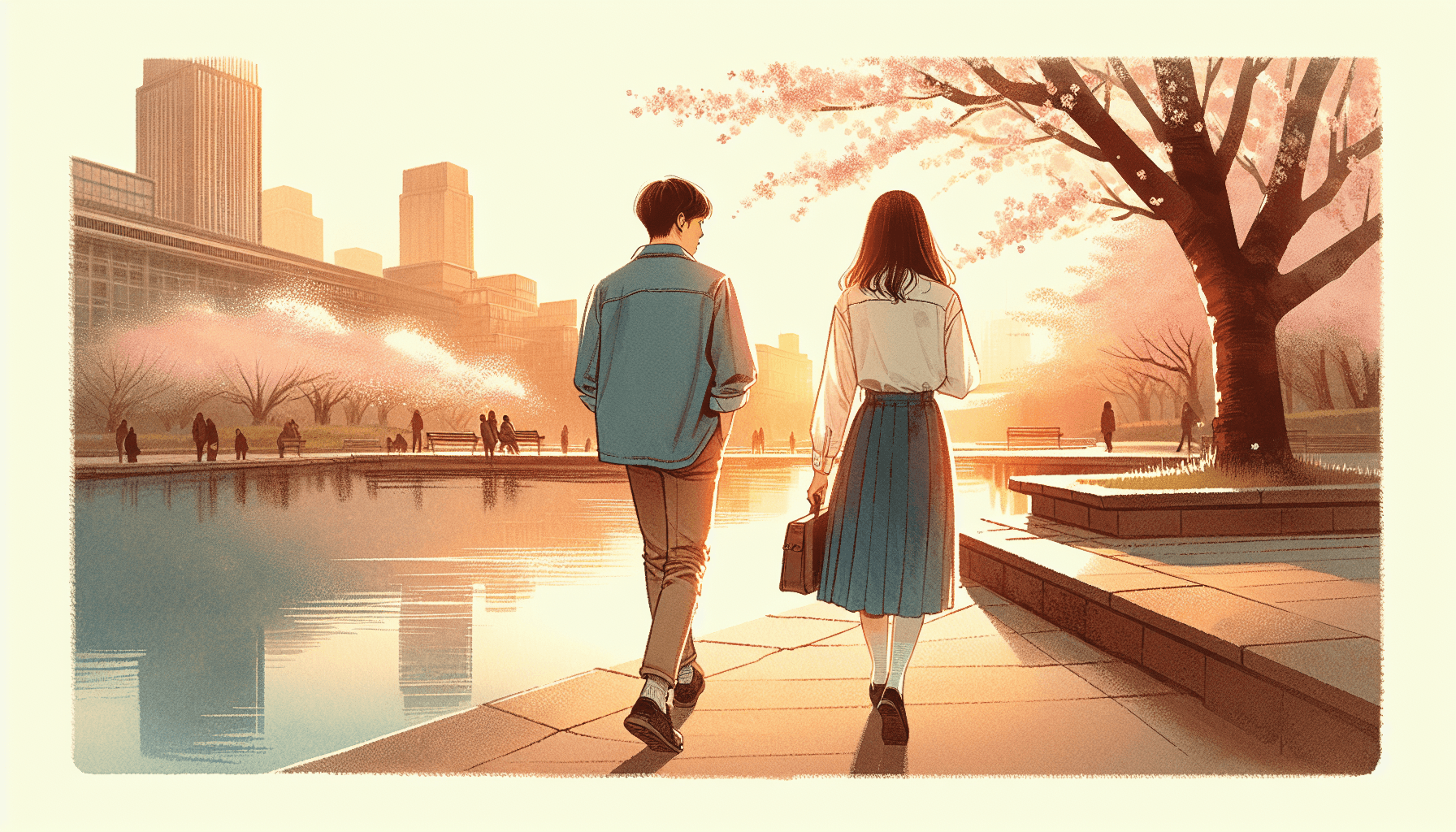
It was afternoon. The café was nearly empty. We sat by the window, talking about nothing in particular, watching people walk by outside. Late spring — not quite warm, not quite cool. Outside, some wore short sleeves; others still had sweaters on. In this city, only in this drowsy, indulgent season — when nature couldn't be bothered to impose the constraints of heat or cold — could people dress exactly as they pleased.
Chuchu wore a white t-shirt under a loose orange fleece jacket, light blue jeans, canvas shoes. I wore a black pullover, dark gray jeans, sneakers. Orange usually strikes me as harsh, but on Chuchu it always looked warm and cheerful. The way she leaned against the sofa made everything feel comfortable and right, like sunlight filtering casually through green leaves.
By the time the idea of seeing fish surfaced, we had already spent hours in the café, drifting from one topic to the next. We'd said a great deal, but I couldn't have told you what any of it was about. 98 Degrees had a line in "Invisible Man": You probably spend hours on the phone, talking about nothing at all. Something like that. Being together is a game of exchange — the content doesn't matter. As long as the talking continues, the closeness deepens. Language works that way too. Saying "I miss you" doesn't express the full weight of missing someone, but the way you say it — the tone, the pause — carries more than the words themselves. Between two people in love, you talk without making sense while reading the affection behind each other's words. You say a lot, and none of it means anything, and all of it means everything.
Chuchu and I hadn't reached the stage you'd call "in love." What stage we were at, I couldn't say. Maybe stages don't apply. Friendship isn't a prelude to romance. Though many love stories grow from friendship, calling friendship a warm-up act for love always felt like an insult to both. I'd rather say they can exist side by side, without contradiction.
I liked Chuchu — that much was beyond doubt. The problem was, I had no idea what she thought. She could listen to me say things like "I like you" or "I miss you" with the patient smile of a kindergarten teacher listening to a child tell a story that makes no sense.
"There won't be a story between us." Whenever my confessions became too chaotic, Chuchu would say this with a smile — gentle, sweet, but absolutely certain, like an undeniable truth. It always left me speechless. The reasoning was airtight: I don't deserve you, or you don't deserve me. One of the two. I'd always understood: that God made you, and then made someone specific for you to love, was already an enormous gift. No rule says the person you love has to love you back. Everyone marches forward chasing happiness, ignoring the person running just as hard behind them.
Men who turn love into bitterness are everywhere. Most can't sustain interest in a hopeless cause for long. Passion flares, generosity flows, as if he alone truly cares — and then, finding his efforts futile, he turns cold and walks away to the next pursuit. I suppose Chuchu thought my attention would be the same: temporary. I didn't know whether she wanted me to quietly leave, like all the others, or whether she was waiting for someone persistent enough to prove that he meant it — for as long as it took. If such a person existed, I wanted it to be me.
But questions like these — where only time holds the answer — can't be settled in advance. No matter how firmly I spoke, facing Chuchu's gaze, even I could feel how empty words are. In front of her, all I could do was wait. And even the meaning of waiting grew blurrier with time.
Sometimes I felt that Chuchu looked at me the way a bodhisattva looks down at the suffering world — with pity and compassion, but never stirred. Between us lay an invisible, uncrossable chasm. Nothing I said or did could take me one step further. Perhaps for the rest of my life, I would never move her. Perhaps we would always remain in the café-conversation phase, and perhaps even that fragile arrangement wouldn't last as long as I imagined. Years from now, when I'm very old, looking back — how sad that would be. No matter how happy I was in Chuchu's presence, the moment this thought crossed my mind, grief was always right behind it.
"Come on, what are you spacing out about?" Chuchu's gentle voice pulled me back. We walked out of the café one after the other, heading for our destination. In this landlocked city, the only place to see fish — aside from the terrified ones in restaurant tanks — was the aquarium.
"Isn't it too late to go now?" Chuchu looked worriedly at the setting sun dropping behind buildings outside the taxi window.
"I don't know," I said. "Let's go and see. Even if we can't see the fish, we can see the aquarium itself."
"Do you go often?"
"Actually, I've never been. I've passed by a few times and liked the feeling it gave off — the sense of the ocean. I do like the sea, genuinely."
"Nonsense," Chuchu said. "You grew up by the Yellow River."
"That's different. The Yellow River has grandeur, but it doesn't feel like water, not really. Not like the gentle rivers of Jiangnan, not like the open sea. Maybe after roaring across the dry plateau for so long, it forgot what being water was supposed to feel like."
"You're reaching," Chuchu said. "All this Jiangnan and ocean talk is just in your head. You had a real river right there, and instead you chased some imaginary ideal of water. That doesn't sound like a very happy childhood."
"It's not imaginary. The first time I saw Jiangnan, I was on a train. I woke up one morning and there they were — white houses surrounded by patches of water, a pavilion on a small lake, the sun rising slowly on one side of the tracks. I thought: this is what real water looks like, gentle and embracing. And only a place like this could produce someone like Chuchu — a Jiangnan woman from Dai Wangshu's Rain Alley, fragrant as lilac and touched with sorrow."
"Flattery. You didn't even know me then."
"Time can take detours," I admitted — basically confessing I was making things up as I went. I always said things to Chuchu that sounded like flattery. To me, every word was sincere — I just couldn't find plainer ways to say them. Even to my own ears, it sounded glib. But the feeling was real, and explaining that only made things worse. After a few failed attempts, I gave up — she'd see it eventually. I went on: "Even back then, I was certain that someday I'd meet a woman like Chuchu. It's just that" — I squinted and made a pained face, imitating a character from a movie — "I guessed how it would begin, but I didn't guess the ending." Chuchu pretended not to notice.
Before we knew it, we were at the aquarium entrance. The sky was remarkably blue. The towering building rose above us like a great ship sailing through it.