Leaving the Forest
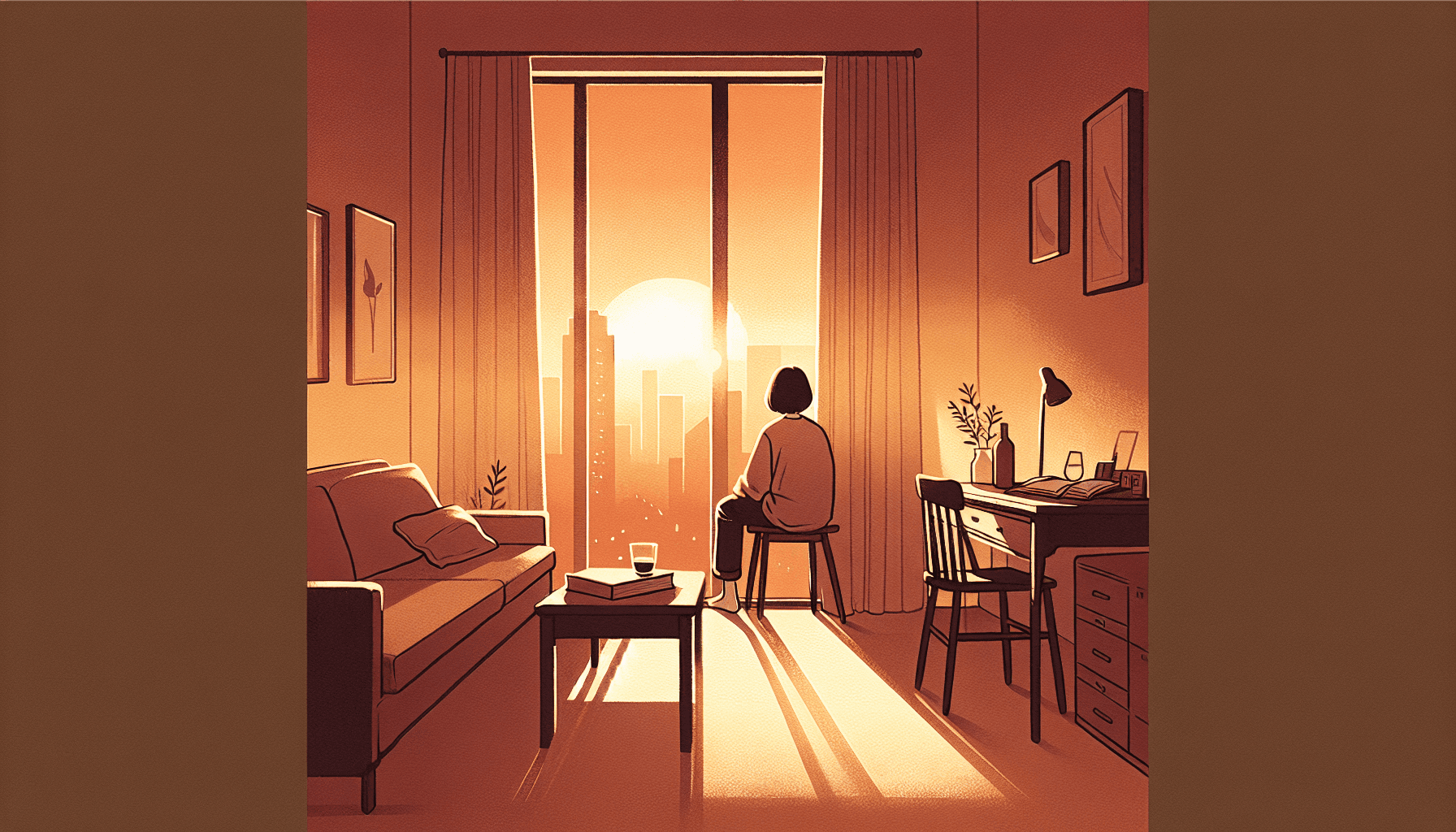
I poured myself a glass of sparkling wine, sitting on the couch by the small desk. Outside, the sun was going down, the last light falling across the balcony. The buildings around me were starting to glow. I opened the door and stepped out, leaning against the railing. This city has never been quiet — opening any window brings noise in. That usually bothers me. But right then, it felt solid, reassuring, like proof that the world's enormous machinery was still running. That was exactly what I needed.
A few minutes earlier, I had finished the audiobook of Norwegian Wood. I never thought I could sit through thirteen hours of audio, especially in English. Yet from the first minute, I was pulled in completely. Every word came through clearly, as if the language had dissolved into something already mine — the narrator's voice a melody I had somehow always known.
Over the past twenty-five years, I've read this book many times. Five, maybe ten. My familiarity with the story turned every sentence into a vivid scene in my mind, sharpening what the narrator delivered.
Time slipped by without notice. I walked deeper into the story the way I've walked through that forest for years. Each visit brings something different — shaped by the season, shaped by my age. This time felt markedly different; perhaps because I had never listened to a book like this before, or perhaps because I had never made it through an entire English text. I had to pay close attention, following the narrator step by step, which is nothing like reading at my own pace. I noticed details I might have skipped before. I found new elements in a landscape I thought I knew by heart.
This audiobook journey reminded me of my first long drive. Before that trip — over 1,300 kilometers — I couldn't imagine driving more than 200 alone. Afterward, my sense of distance shifted; now, 500 to 800 kilometers feels short. I believe that after these thirteen hours, my definition of "long audio" has changed in much the same way.
My sense of time has shifted too. Like that long drive, when I was young I could barely plan a few years ahead. Living in the present was all I could manage, though I looked forward to summer and winter breaks, looked forward to letters being answered. I couldn't picture what lay beyond. Now, twenty-five years after I first picked up Norwegian Wood, my sense of time has changed completely. I can barely recall when, across all those years, I read it so many times — but those moments happened, blending into other memories. As I age, memories flatten in my mind; their order blurs; telling memory from dream from imagination becomes difficult. But it doesn't matter. They exist in my head regardless, unknown and unimportant to anyone else. No matter how much I think about the truth or timing of past events, I cannot go back. Not by a single second. I just need to live, and leave space deliberately blank.
Yet certain scenes remain more alive in my memory than my own experiences. I remember Aureliano Buendía facing the firing squad. I remember an old woman being approached by a man in the entrance hall of a public place. I remember an old man with 622 love affairs telling an old woman he had waited for her fifty-one years, nine months, and four days. I remember a boy of twelve or thirteen declaring that the cousin visiting his house for the first time was a girl he had met before, somewhere. Among all these scenes, what I really want to highlight are the forests and meadows where Watanabe and Naoko walked, the Boeing 747 landing at the Berlin airport, Naoko's birthday night, and Midori with no one to call out to. Norwegian Wood has profoundly shaped my life — how I make friends, how I write, how I love, how I see the world.
From the vantage point of thirty-seven, looking back at my life when I first read the book, it seemed impossible to imagine ever reaching that age. But now thirty-seven is already behind me, and there's no going back. Only in stories do people live from seventeen to twenty and then return to seventeen; only in stories does a thirty-seven-year-old man keep looking back at his early years without growing older. In the real world, time never stops.
Over the past week, I listened to the audiobook whenever I had a chance. It ended too quickly. Then, suddenly, a realization — a voice telling me I had been in the forest too long. It was time to leave. And it was true. I had been lost in Norwegian Wood for too long. I've read all of Murakami's other novels, but none has marked me the way this one has. I read the books mentioned in it — The Magic Mountain, The Great Gatsby. I listened to the music it mentioned and fell in love with some of it. I wanted to help everyone I cared about, seeing them as victims like Naoko. But most people are perfectly fine. They neither need nor understand that peculiar urge to help.
It seems I've been trapped in the world of Norwegian Wood. Indeed, it's time to leave — just as Watanabe chose to live bravely again without Naoko. This realization stings again; as long as I keep thinking this way, I may never leave. But it doesn't matter. This isn't a real forest. I can decide whether to stay or go. And again, like the metaphor of the well in the forest, whether it's real doesn't matter.
The audiobook ended. So did my walk in the forest. I'll finish this glass and go to sleep. I hope I sleep well. After all, tomorrow is another day.